
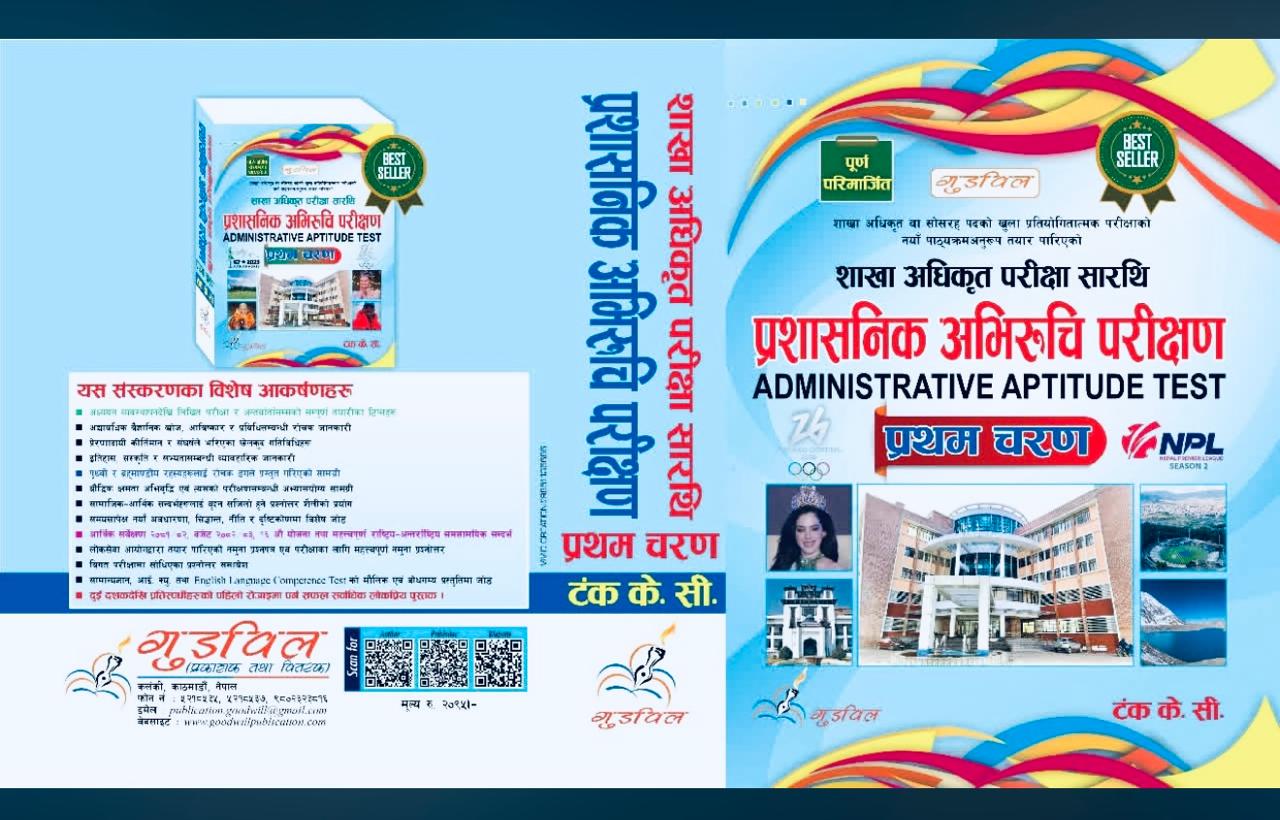
Section Officer Exam Sarathi
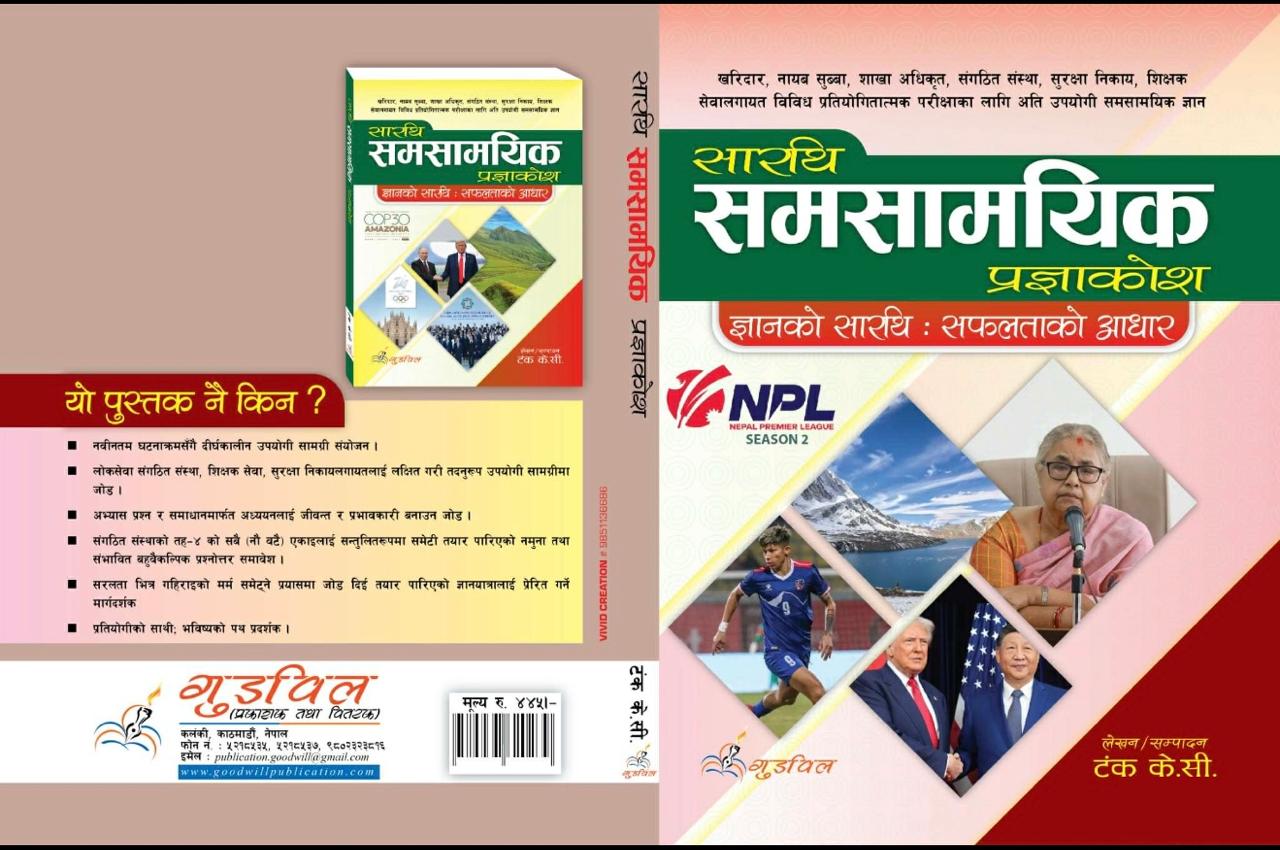
Prepare for the Section Officer (Shaakha Adhikrit) exam with Tanka K.C.’s latest Exam Sarathi. Based on the new 2081/82 integrated syllabus, this book covers the Administrative Aptitude Test (AAT) in detail, offering a structured path through the preliminary screening, main written papers, and final skill tests for all non-technical services.
The "Shaakha
Adhikrit Pariksha Sarathi" (Section Officer Exam Pilot) is a
specialized guidebook designed for candidates preparing for the Public Service
Commission's (PSC) competitive exams. This edition is meticulously crafted
according to the New Integrated and Unified Examination System approved
on 2081/03/20.
Highlighted Features
·
Targeted for All Services: Specifically designed
for Non-Technical services including Justice, Foreign Affairs, Administration,
Audit, and Parliament.
·
First Paper Mastery: Deep focus on the Administrative Aptitude
Test (AAT), covering General Awareness, Aptitude, and English Competence.
·
Comprehensive Stages: Detailed roadmap for Stage I (Preliminary),
Stage II (Main), and the Final Interview/Skill Test stages.
·
Latest Curriculum: Includes updated topics on Geography,
History, Sustainable Development, and International Relations relevant for the
2081/82 advertisement cycle.
Detailed Description: The Integrated
Examination Path
Stage I: Preliminary Screening (AAT)
This book
provides extensive preparation for the First Paper, which consists of
100 objective questions.
·
General Awareness (50 Marks): Insights into Nepal’s
geography, history, and socio-economic systems.
·
Aptitude Test (30 Marks): Covers verbal,
non-verbal, and quantitative reasoning with logical analysis.
·
English Competence (20 Marks): Designed to test
vocabulary, syntactic ability, and reading comprehension at a Class XII
proficiency level.
Stage II: Main Examination & Beyond
Prepare
for the subjective transition into governance and contemporary issues.
·
Subjective Focus: Guidance on Governance Systems, Contemporary
Issues, and Service-Related subjects.
·
Specialized Tracks: Additional guidance for candidates applying
for the Nepal Foreign Service.
· Skill Testing: Preparation modules for Information Technology (IT) skill tests, including Devanagari and English typing.
Why Choose This Book?
·
Targeted Coverage: Specifically tailored for Non-Technical
services including Justice, Foreign Affairs, Administration, Audit, and
Parliament.
·
First Paper Mastery: Focuses on the Administrative Aptitude
Test (AAT), which is the mandatory first step for all candidates.
·
Updated Curriculum: Reflects the syllabus changes approved on 2081/03/20,
applicable for the 2081/82 advertisement cycle.
· Result-Oriented: Designed to help you achieve the 45% pass mark required to qualify for the Main Examination.
Table of Contents (Simplified)
|
Section |
Topic |
Details |
|
Part I |
General
Awareness (50 Marks) |
Geography
(Nepal & World), History, Socio-Cultural Systems, Economy, Sustainable
Development, and Science & Technology. |
|
Part II |
Aptitude
Test (30 Marks) |
Verbal
Reasoning, Non-verbal Reasoning, Quantitative Aptitude, and Data
Interpretation. |
|
Part III |
English
Language Competence (20 Marks) |
Reading
Comprehension, Vocabulary building, and Syntactic (Grammar) Ability. |
|
Part IV |
Exam
Schemes & Guidelines |
Rules
for Stage I (Preliminary), Stage II (Main), and Final Stage (IT
Skills/Interview). |
|
Appendix |
Contemporary
Affairs |
National
and International events of political, economic, and scientific importance. |
About the Author
Tanka K.C. is a highly respected
figure in the field of Public Service Commission preparation. Known for his
clarity and exam-centric writing style, his works have guided thousands of
students through the rigorous selection process of the Nepal Civil Service.
Key Exam
Tip: Remember
that the Preliminary Examination is a screening test. While these marks aren't
added to your final score, you must score at least 45 marks to sit for the Main
Exam.
Would
you like me to generate a set of sample practice
questions based on the General Awareness section of this book?
.png)
.png)